The Industrialization of Nuclear Energy

Synopsis
In February 2026, Valar Atomics airlifted the unfueled components of a nuclear microreactor aboard three military cargo planes — evidence, the company argues, that nuclear reactors can now be manufactured like products rather than constructed as one-off megaprojects. This publication explores the technology behind Ward 250, a helium-cooled, TRISO-fueled reactor that reached criticality in roughly nine months, as well as the manufacturing philosophy — borrowed from Wrights law — behind the idea that mass production could drive down nuclear costs just as it did for solar panels and batteries. It also examines the coalition of Nvidia, the U.S. Department of Energy, the military, and state government that compressed regulatory and industrial timelines once measured in decades into a matter of months — and why AI’s colossal appetite for electricity may be the catalyst accelerating it all.
"An academic reactor or reactor plant almost always has the following basic characteristics: it is simple, it is small, it is cheap... it can be built very quickly... On the other hand, a practical reactor can be distinguished by the following characteristics: it is being built now, it is behind schedule, it requires an immense amount of development on apparently trivial items."
— Admiral Hyman Rickover, "Paper Reactors, Real Reactors" (1953)
73 years later, it is suffice to say that these academic reactors are now becoming a reality.
Take a second and imagine a nuclear reactor being airlifted by three separate C-17 Globemaster aircraft.
Three of the largest military cargo planes in the U.S. fleet, each hauling a piece of something that, until pretty recently, required a decade of permitting and a construction site the size of a small town.
This is exactly what happened with one of Valar Atomics’ nuclear reactors.
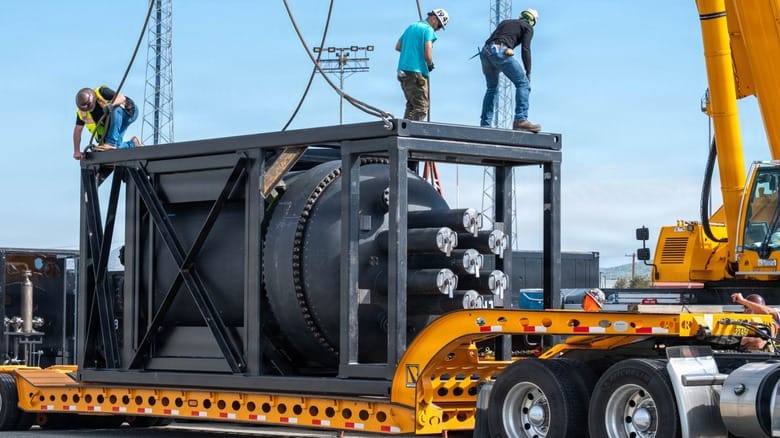
In February 2026, the unfueled modular components of the reactor were trucked to March Air Reserve Base near Riverside in Southern California, loaded onto three U.S. Air Force C-17s, and flown to Utah for final assembly and testing.
The whole point, as the company puts it, is that a reactor built like this can be rapidly transported and deployed to a military base that needs consistent power in a remote location — or used to power AI’s ravenous appetite for energy.
Evidently, this isn’t the nuclear reactor you’re used to.
Disregard the immense cooling towers, the sprawling containment domes, and the water reservoirs the size of lakes.
What flew to Utah was small enough that huge portions of the reactor fit inside packages that could, quite literally, travel through the clouds.
So what actually is this thing?
Valar's reactor, called Ward 250, belongs to a category called a high-temperature gas-cooled reactor, or HTGR. Where a conventional nuclear plant circulates pressurized water through the core to move heat away from the fuel, Ward 250 circulates helium — an inert gas that can't become radioactive on contact and can't flash into steam in a loss-of-coolant accident.
The fuel itself is the more interesting part.
It's called TRISO — tri-structural isotropic; and each particle is roughly the size of a poppy seed, with a uranium kernel wrapped in ceramic layers and a silicon carbide shell that functions as its own individual containment vault.
Because each particle is essentially a self-contained unit, TRISO is considered one of the more robust nuclear fuel forms developed — paramount for a reactor that's meant to be shipped around and dropped into varied locations.
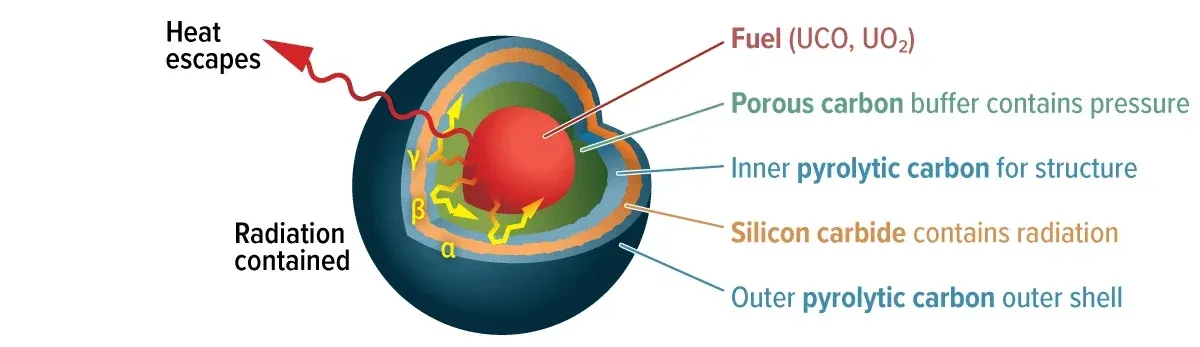
The key is not that TRISO retains some universal percentage of every fission product. Retention varies by isotope, temperature, and operating condition. What has been demonstrated, however, is unusually strong performance under severe irradiation.
In the U.S. Department of Energy’s AGR-1 qualification program, uranium oxycarbide (UCO) TRISO fuel reached a peak burnup of 19.6% FIMA, with no complete TRISO coating failures detected among roughly 298,000 particles. Subsequent heating tests exposed irradiated fuel to temperatures as high as 1,800°C while still showing very low release rates for many important fission products.
In moving a critical layer of containment directly into the fuel itself, if reactor temperatures rise during an accident, much of the radioactive inventory can remain trapped inside millions of individually coated fuel particles rather than becoming immediately available for release.
For now, Ward 250 remains a test article, rated at 100 kilowatts of thermal output for its criticality demonstration. The longer-term design path, however, points toward a system capable of producing 5 megawatts of electricity.
To put that target in perspective, 5 MW could supply electricity on the order of several thousand homes, depending on local consumption and capacity assumptions. That is only a fraction of the output of a conventional nuclear plant, which is precisely the point.
The company's strategy is to build what it calls “gigasites”: clusters of hundreds of small HTGR's producing industrial power and carbon-based fuels at a large scale.
Pretty straightforward: standardize the reactor, manufacture it repeatedly, and aggregate as many units as a site requires.
The electricity-generation side is relatively conventional at this stage. During Valar’s July power demonstration, heat removed from the reactor through its helium cooling system was converted into electricity using a thermoelectric generator, demonstrating that reactor heat could be turned into usable electrical power.
For larger-scale generation, Valar is developing a Brayton-cycle power-conversion system in which heat from the reactor is transferred to a secondary loop that drives high-speed turbo machinery. The working fluid could ultimately be helium, supercritical carbon dioxide, or another gas, depending on the final design.
Ward 250 has not yet demonstrated that commercial-scale configuration. What it's beginning to test, however, is that previous proposition: whether a common reactor architecture can serve as the repeatable building block of a much larger industrial energy system.
Reactors as a learning curve
A useful way to understand Valar Atomics’ manufacturing strategy is through the logic of Wright’s Law, a principle derived from 1930s aviation economics. Valar’s argument isn't only that smaller reactors are cheaper to build, but with repeated production of a standardized reactor design, it could generate cumulative efficiency gains that progressively reduce unit costs.
The principle originates with aeronautical engineer Theodore Wright, who observed in 1936 that the labor required to manufacture an aircraft tended to decline by a relatively consistent percentage each time cumulative production doubled. Although Wright’s original analysis focused primarily on labor hours, as it was the cleanest data available at the time, the significance of the learning curve lies in its ability to capture the efficiencies produced by repetition. As production increases, manufacturers refine tooling, improve supply chains, reduce waste, streamline assembly processes, and incorporate lessons from earlier units into later ones.
This logic has been used to help explain the long-term cost declines observed in technologies such as solar photovoltaics and lithium-ion batteries, both of which became substantially cheaper as global production expanded. Valar’s thesis is that nuclear energy can follow a similar trajectory.
The number that actually matters isn't the valuation
In early August 2026, Sequoia led a USD 1 billion financing round for Valar Atomics at a reported 6 billion dollars post-money valuation.
The number itself was extraordinary. But perhaps more interesting was how quickly investors had arrived at it.
Eighteen months earlier, Valar had raised just 19 million dollars in seed financing. By March 2026, a 450 million dollar round valued the company at roughly 2 billion dollars. Four months later, that figure had tripled.
What had changed in those four months?
Certainly, the company hadn't become three times as large in any conventional sense. Nuclear infrastructure is not software. Reactors can't be scaled by adding servers, and engineering timelines do not shrink simply because more capital becomes available.
Yet the market was assigning dramatically more value to the same inherent ambition.
One way to understand this is to look beyond the capital itself and toward the uncertainty that capital was pricing.
For much of its early life, Valar represented a collection of technical promises. Ward 250 offered a particular vision of what nuclear power could become, but there remained a meaningful distance between the possibility of a working reactor and the evidence of one.
As Ward 250 demonstrated criticality, increased power output, and the ability to power real hardware, that distance began to close.
Which then leads to the question: why did private capital, the Department of Energy, the military, and companies such as Nvidia begin aligning around advanced nuclear at roughly the same moment — and what changed technologically, economically, and politically to make a development cycle once measured in decades appear compressible into years?
Nvidia and the State
There is another dimension to Valar's progress that is easy to overlook when the story is told primarily through financing rounds and reactor milestones. It concerns the institutions gathering around the company, and the extent to which their involvement may be changing the conditions under which nuclear technology gets developed.
The growing relationship between artificial intelligence and nuclear energy is often described as a matter of demand. AI companies require enormous quantities of electricity, and nuclear power offers the prospect of reliable, continuous generation. But demand alone does not explain the speed of Valar's development. What makes the company's trajectory interesting is the possibility that some of the institutions creating this demand are also beginning to shape the process through which new nuclear capacity becomes available.
Consider Nvidia.
Shortly before Valar's Series B financing closed, Ward 250 reportedly became the first reactor in the United States to directly power an Nvidia AI chip, converting reactor heat into electricity during a live demonstration.
The practical significance of powering a single chip should not be overstated. A demonstration is still a good distance from supplying electricity to a commercial data center. Yet its technical significance is worth analyzing.
This brings an interesting question. What happens when the companies driving electricity demand begin shaping not only what gets built to meet it, but the conditions under which it gets built?
The federal government's involvement introduces a different dimension.
Ward 250's reported achievement of criticality occurred under the Department of Energy's Reactor Pilot Program, established following a May 2025 executive order that set a target of at least three advanced reactors reaching criticality by July 4, 2026, the 250th anniversary of American independence.
This choice of deadline is interesting. Nuclear development has traditionally been governed by extended sequences of engineering validation, regulatory review, construction, and testing. Here, the federal government had attached a specific technological milestone to a national political timetable. The significance obviously, that the demonstration of progress had become an outright institutional priority.
Additionally, the February airlift of reactor components further illustrates this changing relationship. Rather than relying entirely on conventional commercial logistics, the operation involved coordination between the Department of Energy and the Defense Department, with Energy Secretary Chris Wright accompanying the flight and connecting the project to questions of military energy resilience.
At the state level, Valar's development also intersects with Utah Governor Spencer Cox's Operation Gigawatt, an initiative aimed at doubling the state's electricity production within a decade.
"I don't see a way for us to get there without nuclear."
— Sam Altman, CNBC, 2023
"Energy is the only universal currency; it is necessary for getting anything done."
— Vaclav Smil, Energy and Civilization: A History (2018)
The Industrialization of Nuclear Energy
Coal did not, in isolation, cause the Industrial Revolution, but it helped remove one of the fundamental limitations on what industrial civilization could achieve. Its significance indeed rests on the energy it provided, but also in the vast systems of production, transportation, and commerce that developed around it. Oil subsequently transformed global industry through its energy density, transportability, and compatibility with internal combustion engines.
In both cases, the economic importance of the resource grew as societies learned to harness it at scale. The history of industrialization demonstrates that technological progress depends as much on the institutions and infrastructure surrounding an invention as on the invention itself. Nuclear energy presents a paradox in this regard: it offers one of the most concentrated sources of energy ever harnessed, yet its deployment has remained exceptionally slow, expensive, and difficult to replicate at scale.
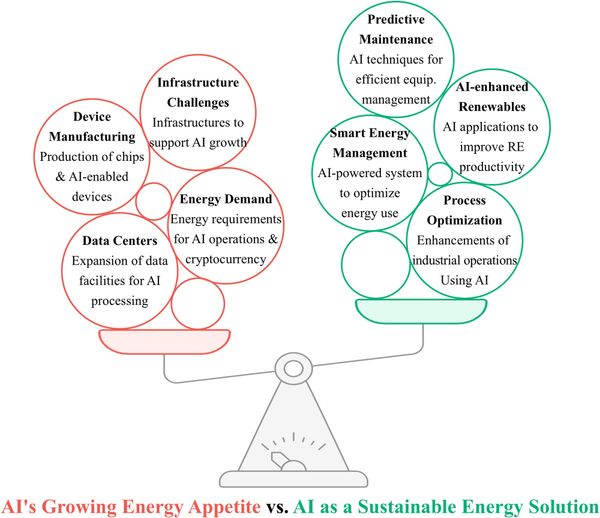
Artificial intelligence is bringing renewed attention to that contradiction. The International Energy Agency estimates that data centres consumed approximately 485 terawatt-hours of electricity in 2025, with demand projected to approach 950 TWh by 2030. Computational capacity can expand rapidly, however the infrastructure required to sustain it operates on extended timelines. The challenge is then delivering sufficient power reliably, economically, and precisely where it is needed, each posing a distinct challenge. Renewables, storage, and grid expansion will keep playing essential roles, but the concentrated and continuous demand of large computing facilities creates a particular opening for nuclear generation. What makes this moment advantageous for acceleration is rather the growing urgency surrounding electricity supply which is creating the economic conditions needed to overcome the industrial limitations that have constrained nuclear energy for decades.
This is perhaps the greater significance of Valar Atomics and the emerging generation of advanced nuclear companies. Their ambition extends beyond demonstrating that a reactor can work to establishing whether reactors can be manufactured, financed, and deployed through standardized, repeatable processes. Valar's reported progress, together with the convergence of private capital, industrial demand, and government support, offers an early indication that the conditions for nuclear industrialization may be changing. Nevertheless, a successful demonstration is not proof of commercial viability, and prominent institutional coordination alone cannot establish an industry capable of consistently reproducing its achievements at scale.
The deeper question is whether the urgency created by artificial intelligence can do for nuclear energy what earlier industrial transformations accomplished for coal and oil: turn an extraordinary source of power into the foundation of a repeatable industrial system. Nuclear energy has possessed remarkable physical capabilities for generations, in spite of that the industrial systems needed to utilize it reliably and at scale have remained elusive. Perhaps what is most changing now is the conditions under which it can become commonplace. If so, the defining achievement of companies like Valar may in the long run be measured less by how quickly they build their first reactors than by how routinely, economically, and predictably they can build the hundred that follow.