Jevons Paradox & Environmental Stewardship in the Fifth Industrial Revolution
The first Industrial Revolution cultivated steam and mechanized labour, guiding humanity from the fields into the factory and birthing the modern economy. The second fused electricity, steel, and the assembly line, delivering mass affluence at the price of unprecedented production; automobiles and the telephone burgeoned here. The third Revolution discharged computers and digital networks, automating thought itself and collapsing distance into an interconnected global marketplace. The fourth combined the physical and the virtual together — cyber-physical systems, the Internet of Things (IoT), and oceans of data, giving rise to intelligent factories and hyper-connected supply chains. Now the Fifth Industrial Revolution is here, defined as the Cognitive Age, poised to revamp essentially everything that came before.
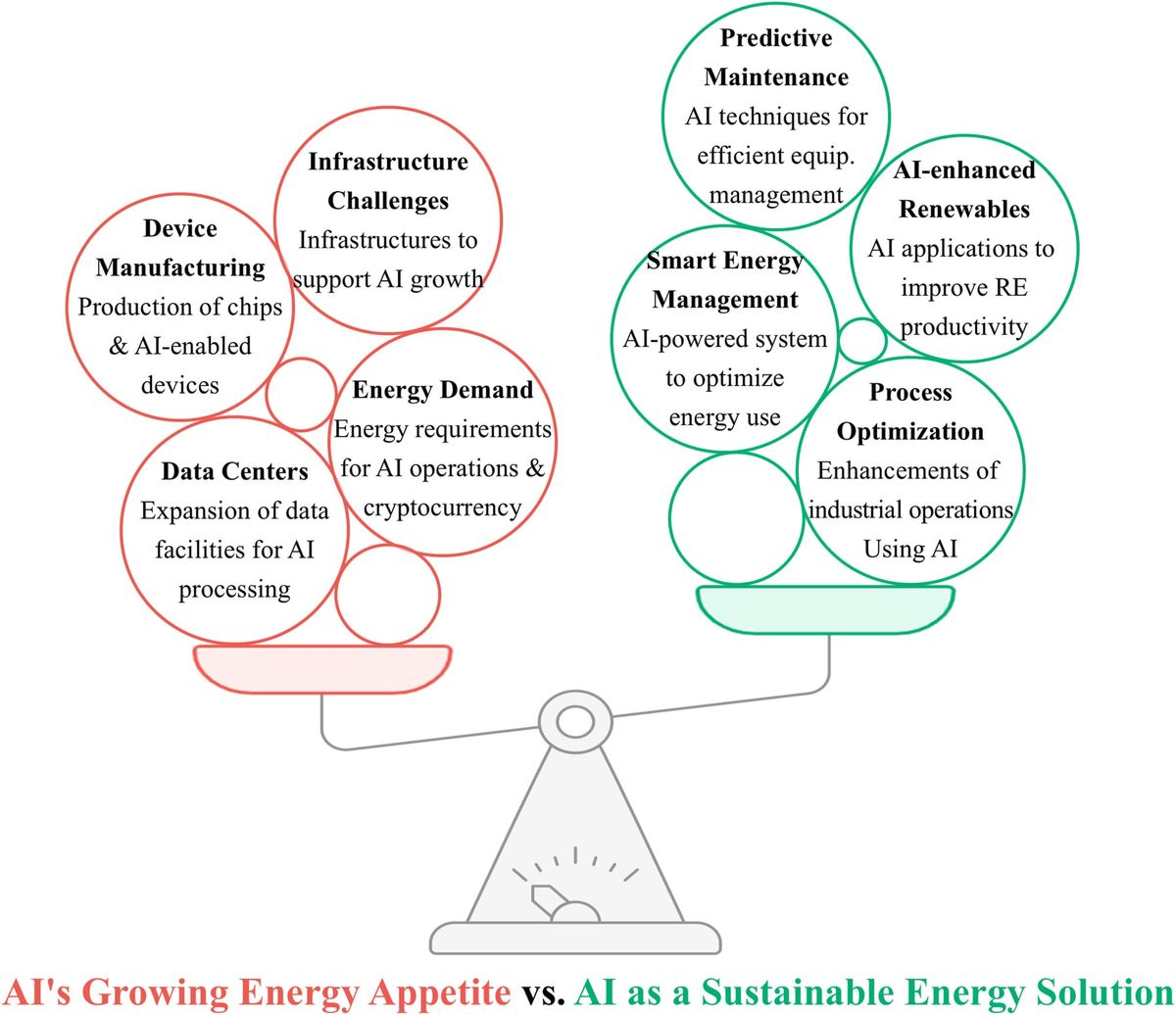
AI is already reshaping employment, knowledge creation, and the intricacies of daily life, connecting through every layer of economic and social organization. This cognitive leap however rests upon a vast and voracious physical foundation: the computing hardware and data-centre infrastructure required to sustain widespread automation (a critical topic I will write about soon), above all the AI systems that distil meaning and value from torrents of data.
These facilities have become one of the fastest-growing sources of electricity demand on Earth. Among the looming shadow of worsening climate change, the imperative for sustainable, low-carbon energy solutions has never been more acute.
Despite heavy investments in wind, solar, geothermal, and nuclear power, major tech companies have turned to natural gas plants to meet surging AI-driven demand, causing their total greenhouse gas emissions to rise even as they pursue ambitious net-zero targets.
Alphabet has called its net-zero 2030 goal a “moonshot” after dropping an earlier carbon-neutral pledge; it is partially powering a North Texas data center with natural gas while its overall emissions grew 54% from 2019 to 2024.
Amazon is building natural-gas facilities in Mississippi and Indiana and views nuclear as essential, however its emissions have climbed 33% since 2019.
Meta is constructing large gas-powered plants, including a 5-gigawatt site in Louisiana, and has seen emissions surge over 60% (with data center electricity nearly tripling) between 2020 and 2024.
Microsoft signed a deal with Chevron for new gas capacity shortly after securing restarted nuclear reactors at Three Mile Island (expected online in 2027); its emissions have risen 23% and electricity use has more than doubled since 2020.
All four companies report improved efficiency per computation, however at the convergence of digitalization and the decarbonization of energy lie many challenges, such as Jevons paradox.
How we power the infrastructure of powerful AI will decide whether the Fifth Industrial Revolution becomes a new era of shared prosperity and planetary stewardship, or a new vector of environmental strain that undermines the very progress it promises.
Is environmental cost an inevitable byproduct of technological progress? or are there a multitude of things we can be optimizing instead? Keep this in mind for future reference.
Smart energy management and ASI
Machine learning algorithms are already being harnessed to sharpen weather forecasts for wind and solar generation, orchestrate grid operations with real-time capabilities, and extract greater performance from energy-storage systems — notions that promise to smooth the integration of variable renewables and accelerate the efficiency gains essential to a stable, low-carbon power system.
These applications directly support the international commitment to triple renewable energy capacity and double the global rate of energy-efficiency improvement by 2030, while simultaneously beginning to reduce the energy footprint of AI itself. As we discussed briefly in the previous publication, uranium as a clean energy source will become a much bigger player as time goes, aiding in these efforts.
For now, the energy appetite of AI systems — particularly those powering machine learning like deep neural networks and large language models, are outpacing efficiency gains at a great rate. Computing power required for frontier AI has been doubling roughly every one hundred days, while a single generative query now consumes nearly ten times the electricity of a conventional internet search.
Arguments I have heard involve how artificial superintelligence (ASI), if even realized, could eventually help mitigate or even reverse most of the environmental damage associated with the expansion of digital infrastructure. However this line of reasoning remains extremely speculative. There is still no consensus that artificial superintelligence is achievable at all, and even among those who consider it plausible, projected timelines range from a couple years to several decades into the future.
Such uncertainty makes it a profoundly insufficient basis for present policy or industrial planning. The climate and ecological pressures associated with data centre expansion are unfolding now, and they demand immediate, concrete responses on a global level rather than deferred hope in a still-hypothetical technological outcome.
As discussed before, according to the International Energy Agency, electricity demand from AI, data centres, and related activities could more than double later this decade, surpassing approximately a thousand terawatt-hours — roughly equivalent to Japan’s entire national consumption. This surge is already straining electrical grids, risking blackouts in tight markets.
All aside, improvements in algorithmic efficiency risk triggering Jevons Paradox — a counterintuitive idea in the history of economics and environmental thought.
Essentially, the paradox states that technological improvements which increase the efficiency with which a resource is used often lead not to reduced consumption of that resource, but to an increase in its total use.
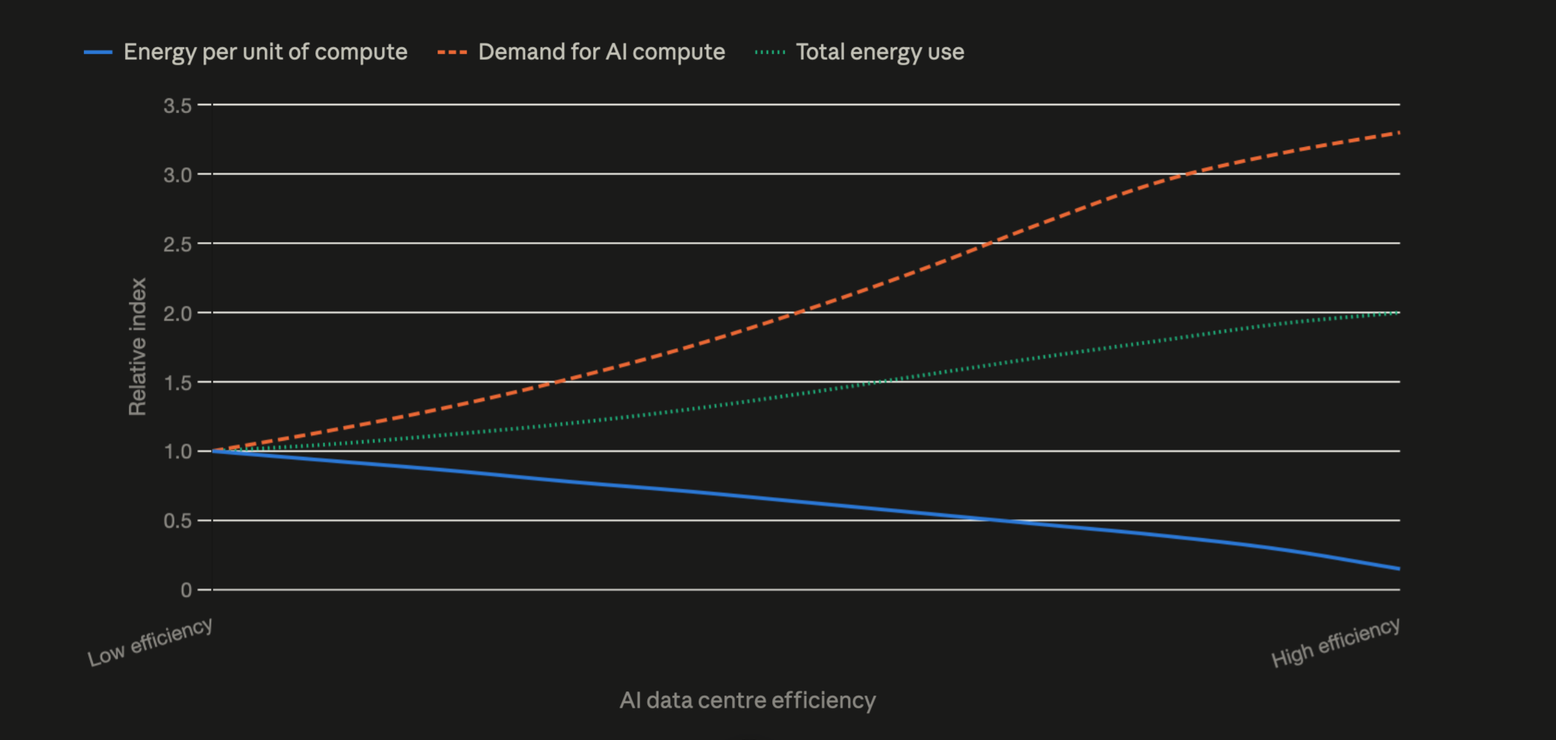
Greater efficiency lowers the effective cost of using the resource, which, when demand is price-elastic, stimulates greater quantity demanded.
Savings are consumed rather than hoarded. In other words, abundance breeds appetite.
Let's examine some history to understand the present. The paradox takes its name from the English economist William Stanley Jevons, who articulated it in his 1865 book The Coal Question. Jevons was writing at the height of Britain’s Industrial Revolution, amid widespread anxiety that the nation’s coal reserves were nearing exhaustion. Various contemporaries believed that James Watt’s improvements to the steam engine — much more efficient than Thomas Newcomen’s earlier design, would conserve coal and postpone the crisis.
Jevons argued precisely the opposite. Because the new engines made coal far cheaper to use in a widening array of industrial applications, coal became attractive for purposes previously uneconomic. The result was not conservation as intended but a surge in total consumption across ironworks, railways, factories, and shipping. Jevons captured the insight: “It is wholly a confusion of ideas to suppose that the economical use of fuel is equivalent to a diminished consumption. The very contrary is the truth.”
Advances in GPU efficiency, algorithmic optimization, and cooling systems have slashed the energy cost per computation or per token generated. Yet precisely because intelligence has become cheaper and more powerful, demand as we see has exploded. Training runs that once seemed extravagant are now the new normal. As mentioned data-centre electricity demand is projected to double or more later this decade, even as individual operations become “greener.”
Of course, my point here is not that efficiency is futile, but that it is insufficient on its own. Technological progress expands the feasible frontier; it does not automatically align human behaviour with planetary limits. Without complementary policy frameworks — carbon pricing, cap-and-trade systems, enforced autoscaling, expansion of renewable energy, consumption taxes to change incentives, efficiency improvements risk becoming vectors of accelerated depletion rather than instruments of conservation.
Jevons was no Luddite; he praised the wealth and progress that coal had made possible. His warning was that optimism grounded solely in engineering arithmetic was by far incomplete.
In this period defined by artificial intelligence and the pressing need to decarbonize, Jevons’ Paradox will serve as a call towards not just foresight and operational discipline, but also policy sophistication.
Undoubtably, efficiency must remain a central pillar of any real sustainability strategy — there is no path to net-zero without it. But it must be paired with deliberate mechanisms that constrain total resource flows.
Otherwise, the very ingenuity that powers the Fifth Industrial Revolution may accelerate the very pressures it was meant to relieve. In the end the real test of our civilization will be whether we have the wisdom to design systems that reward restraint as powerfully as they reward ingenuity. Just think of the marshmallow test.
The Fifth Industrial Revolution will be marked by whether we can govern those intricate feedback loops between computation, energy, and society before their physical costs outrun our capacity to manage them. And as principle, we cannot put our faith on speculative breakthroughs such as artificial super intelligence to clean up our disarray.